

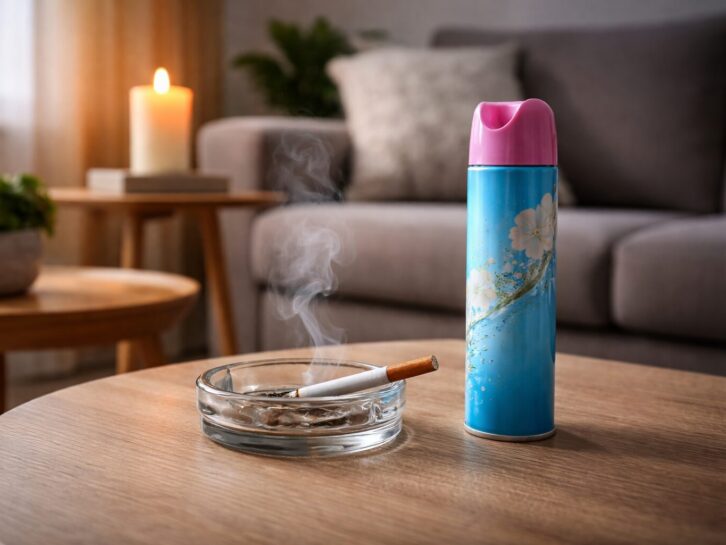
Why Cover-Up Sprays & Air Fresheners Don’t Work — And Can Make Things Worse
Cover-up sprays and air fresheners fail because they mask odors instead of removing the odor-causing compounds. In many cases, added fragrances chemically interact with embedded contaminants, trap moisture, worsen indoor air quality, and create long-term odor rebound that becomes harder to eliminate.
The Persistent Myth of “Smelling Clean”
For decades, cleanliness has been confused with fragrance. If it smells like lemons, pine, or “fresh linen,” the problem must be solved—right?
Not even close.
Odor is not a cosmetic issue. It’s a chemical and biological signal that something is present in the environment. Cover-up sprays and air fresheners don’t remove that signal; they attempt to distract from it. And in doing so, they often create secondary problems that are more difficult—and more expensive—to fix later.
Masking vs. Neutralizing: The Science That Gets Ignored
At the molecular level, odor comes from volatile organic compounds (VOCs) released by bacteria, mold, smoke residues, proteins, or chemical breakdown products. These compounds bind to surfaces and linger in porous materials like carpet, drywall, upholstery, HVAC insulation, and even dust.
Masking
Masking agents:
- Add stronger or more dominant fragrance VOCs
- Temporarily overwhelm the nose
- Do nothing to the original odor source
The odor compounds remain fully intact. Once the fragrance dissipates, the smell returns—often stronger due to environmental changes like humidity or temperature.
Neutralizing
True neutralization:
- Chemically alters or oxidizes odor-causing molecules
- Breaks them into non-odorous components
- Removes the source rather than hiding it
This distinction is not marketing—it’s chemistry.
Why Fragrances Fail Against Embedded Odors
Most problem odors are not floating freely in the air. They are embedded.
Examples include:
- Smoke residues bonded to walls and ceilings
- Pet urine salts crystallized deep in subflooring
- Food grease absorbed into porous surfaces
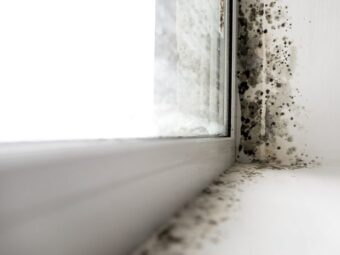
- Mold metabolites trapped inside building materials
Fragrance molecules are lightweight and volatile. They cannot penetrate deeply enough to reach these sources. Instead, they sit in the air or on the surface, offering temporary sensory confusion while the root cause continues to off-gas.
This is why odor “comes back” after:
- HVAC cycles
- Rain or humidity changes
- Temperature shifts
- Occupancy increases
The Hidden Moisture Trap Problem
Many sprays—especially water-based air fresheners—introduce additional moisture into the environment.
That moisture:
- Rehydrates odor-producing bacteria
- Activates dormant mold spores
- Increases VOC off-gassing rates
- Extends the lifespan of odor compounds
In practical terms, spraying can feed the problem instead of fixing it.
This is especially dangerous in:
- Bathrooms
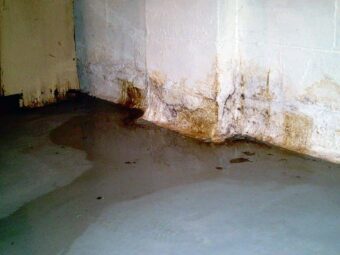
- Basements
- Hotels
- Healthcare settings
- Multi-unit housing
- Commercial kitchens
Fragrance + Odor = New Chemical Problems
Here’s where it gets ugly.
Fragrance VOCs don’t always coexist peacefully with existing contaminants. They can:
- React with ozone in indoor air
- Form secondary pollutants like formaldehyde
- Create heavier, stickier compounds that cling to surfaces
- Increase particulate matter in enclosed spaces
This is why some environments smell “thick” or “chemical” rather than fresh.
You’re not imagining it. That’s chemistry misbehaving.
Indoor Air Quality: The Collateral Damage
Cover-up sprays often increase total VOC load without removing any pollutants.
Consequences include:
- Eye, nose, and throat irritation
- Headaches and fatigue
- Triggered asthma or respiratory distress
- Reduced cognitive performance
- Customer and occupant complaints
In professional environments, this isn’t just unpleasant—it’s a liability.
Odor Rebound: Why It Gets Worse Over Time
Repeated masking creates a phenomenon known as odor rebound:
- Fragrance temporarily suppresses perception
- Odor compounds remain and continue accumulating
- Environmental changes reactivate them
- The returning odor mixes with residual fragrance
- The problem smells stronger, stranger, and harder to eliminate
At this point, simple solutions no longer work. Structural remediation or advanced odor neutralization becomes necessary.
Why Professionals Avoid Masking Solutions
Experienced restoration and cleaning professionals don’t rely on fragrance for one reason: it doesn’t solve anything.
Instead, they focus on:
- Source identification
- Surface penetration
- Chemical neutralization or oxidation
- Moisture control
- Air exchange and filtration
Because the goal isn’t to make a space smell better.
It’s to make it actually clean.
The Smell Test vs. The Science Test
If a product’s primary claim is “long-lasting fragrance,” that’s a red flag.
The real questions are:
- What does it do to odor-causing molecules?
- Does it alter, destroy, or remove them?
- What does it leave behind?
- How does it affect indoor air chemistry?
Clean air is quiet.
Over-fragranced air is usually hiding something.
The Bottom Line
Cover-up sprays and air fresheners:
- Mask instead of eliminate
- Fail against embedded odors
- Can trap moisture and worsen microbial growth
- Increase VOC exposure
- Create odor rebound and long-term problems
They are not solutions. They are delays—and often expensive ones.
True odor control is a chemical process, not a cosmetic one. And once you understand that distinction, the lemon-scented illusion falls apart fast.
FAQs
1. Why do air fresheners stop working after a while?
Because they only mask odors; the source remains and continues producing odor compounds.
2. Can air fresheners make indoor air quality worse?
Yes. They add VOCs and can create secondary pollutants without removing existing ones.
3. Why does odor come back stronger after spraying?
This is odor rebound, caused by masking without neutralization.
4. Do fragrances kill odor-causing bacteria?
No. Fragrance does not disinfect or neutralize microbial sources.
5. Can air fresheners cause headaches or irritation?
Yes. VOC exposure is linked to respiratory and neurological symptoms.
6. Are “natural” air fresheners safer?
Not necessarily. Natural fragrances still release VOCs and do not remove odor sources.
7. Why do professionals avoid scented solutions?
Because they don’t solve the underlying chemical or biological problem.
8. Can sprays trap moisture in surfaces?
Yes, especially water-based products in porous materials.
9. What actually removes odors instead of masking them?
Chemical neutralization, oxidation, and source removal.
10. Is a space truly clean if it smells strong?
Strong fragrance often indicates unresolved contamination.